Why Wetlands Matter
Why are wetlands important?
Wetlands are among the most productive ecosystems in the world, even comparable to rainforests or marine coral reefs and are capable of providing value few other ecosystems can. Wetlands are diverse ecosystems where water is the primary factor controlling the environment and the associated plant and animal life; they are vital for water purification, flood protection, carbon storage, and providing habitat for a vast array of wildlife.
How do wetlands benefit local communities?
Wetlands benefit communities by mitigating flooding, replenishing drinking water, supporting fisheries and agriculture, providing recreational opportunities, and serving as educational sites for learning about wildlife and environmental stewardship.
Wetland Functions

Shoreline Stabilization and Erosion Control
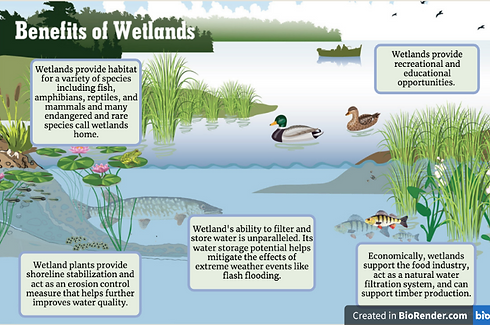
Wetlands that occur along the shoreline of lakes or along the banks of rivers and streams help protect the shoreline soils from the erosive forces of waves and currents. The wetland plants act as a buffer zone by dissipating the water’s energy and providing stability by binding the soils with their extensive root systems
Wildlife Habitat
Many animals depend on wetlands for homes and resting spots. Fish, amphibians, reptiles, aquatic insects and certain mammals need wetlands as a place for their young to be born and grow. Wetlands provide grounds for many U.S. breeding birds to nest and raise their young. Additionally, migratory waterfowl use wetlands as an integral part of their migration journey. Due to the combination of shallow water, high nutrient levels, and high primary productivity, wetlands are able to provide organisms at the base of the food web which has cascading effects throughout the entirety of the wetland ecosystem. Many species of fish utilize wetland habitats for spawning, food sources, or protection.
Flood Control
Wetlands can slow runoff water, minimizing the frequency of flood events. Wetland vegetation slows the speed of floodwater and can distribute the flow more evenly across the landscape. This slowing activity, combined with a wetland’s ability to store and infiltrate water, lowers flood heights and reduces soil erosion. Wetlands near urban centers provide natural protection from flood events and can absorb the excess flow from the impervious surfaces within the community. Wetlands near rural communities can aid in the mitigation of field flooding
Drinking Water Quality
Water Quality” and change text to: Wetlands remove pollutants and harmful substances from water through sediment trapping, plant uptake, and chemical detoxification (converting harmful chemicals into less harmful chemicals). More wetlands in the watershed means less algal blooms in our waterways.
Education
Wetlands provide ideal locations for classroom ecological studies and a focus for art.
Recreation
Wetlands are inviting places for recreational activities including hiking, fishing, bird watching, hunting and boating.
Filtration
By trapping and holding water, wetlands store nutrients and pollutants in the soil, allowing cleaner water to flow into the body of water beyond or below the wetland. Vegetation can absorb some of the pollutants that remain in the soil. Wetlands also moderate water flows, providing time for sediments to settle out before the water is released to other wetlands, lakes, or streams. Less sediment means clearer waters and a better environment for aquatic life.
Groundwater Discharge and Recharge
Some wetlands serve as a source of ground water recharge. By detaining surface waters that would otherwise quickly flow to distant lakes or rivers, the water can percolate into the ground and help ensure long-term supplies of quality groundwater. Some wetlands are ground-water discharge areas; they receive ground water even during dry periods. This helps reduce the impact of short-term droughts on rivers and streams. Natural filter. By trapping and holding water, wetlands store nutrients and pollutants in the soil, allowing cleaner water to flow into the body of water beyond or below the wetland. Vegetation can absorb some of the pollutants that remain in the soil. Wetlands also moderate water flows, providing time for sediments to settle out before the water is released to other wetlands, lakes, or streams. Less sediment means clearer waters and a better environment for aquatic life.
Source of Income
Wetlands provide economic commodities such as cranberries and fish and provide spatial amenities to developments. Their capacity to mitigate flood flow can save monetary loss from flood events in urban centers.
Rare Species Habitat
43 per cent of threatened or endangered species in the U.S. live in or depend on wetlands. This includes plants and animals. Rare species that may occupy wetlands include sandhill cranes, Blanding’s turtles, and prairie fringed orchids.
Threats & Opportunities
Wetland loss and degradation can result from human impacts and natural causes. Human impacts include urban development, pollution, mining, overgrazing, placement of fill material, dredging, deforestation, and alteration of hydrology. Natural threats include erosion and climate change.
More than 90% of Ohio’s wetlands are gone, far exceeding the 50% loss nationally. Many remaining wetlands have been degraded. Wetlands continue to be developed and impacted. The Clean Water Act provides tools to limit wetland impacts, but pressure remains.
The good news is that with careful management and restoration efforts, it is possible to restore their ecological function and biodiversity. In Ohio, the H2Ohio is a statewide water quality initiative designed to address complex issues impacting Ohio’s waters. Launched in 2019, H2Ohio uses a comprehensive approach guided by science and data to reduce algal blooms, stop pollution, and improve access to clean drinking water. Through H2Ohio, the Ohio Department of Agriculture, Ohio Department of Natural Resources, Ohio EPA, and the Ohio Lake Erie Commission each have a significant role to play including reducing nutrient runoff, creating wetlands, and improving access to clean drinking water and quality sewer systems.

Benefits